
Dental Pain: When to See a Dentist and What Counts as an Emergency
It's 2 AM, and a sharp, pulsing sensation in your jaw has made sleep impossible. You're likely lying there wondering if that slight twinge from last week has finally spiralled into a crisis, or if you can safely wait until the morning. We understand how isolating and stressful dental pain can feel, especially when you're caught between the physical discomfort of a throbbing tooth and the worry over unexpected costs.
Understanding the different levels of dental pain when to see dentist is a common challenge for many Aucklanders. Our goal is to provide you with the reassurance and expert knowledge needed to navigate these moments with confidence. In this guide, we will define exactly what constitutes a dental emergency and provide practical, safe strategies for managing discomfort at home. You'll also discover how to access high-quality, affordable care through local options like WINZ-approved quotes, ensuring your peace of mind and oral health remain our priority.
Key Takeaways
-
Learn why the "2-day rule" is a non-negotiable standard for your health and why any discomfort lasting more than 48 hours requires a professional assessment.
-
Identify the critical red flags, such as facial swelling or persistent throbbing, that signal it's time to act regarding dental pain when to see dentist.
-
Understand the subtle differences between common tooth sensitivity and serious decay to prevent minor issues from becoming costly emergencies.
-
Discover safe, effective ways to manage discomfort at home as a temporary bridge until you can reach our centre for a permanent solution.
-
Find out how to access accessible emergency care in Auckland, including the convenience of a clinic open 7 days a week and the availability of free WINZ quotes.
Table of Contents
-
The Top Signs You Need to See an Emergency Dentist Right Now
-
How Stoddard Dental Square Makes Emergency Care Accessible in Auckland
Defining Dental Pain: When Does a Niggle Become a Problem?
Pain is your body's most honest messenger. When it comes to your teeth, a sharp twinge or a dull ache acts as a biological alarm system, signalling that the protective enamel has been breached or the delicate tissues within are under stress. It's a common mistake to hope that a dental niggle will simply fade away like a minor bruise or a common cold. Unfortunately, dental issues are unique in that they don't self-resolve. Without professional intervention, the underlying cause of the discomfort will continue to progress, often quietly, until it reaches a more sensitive or structural part of the tooth.
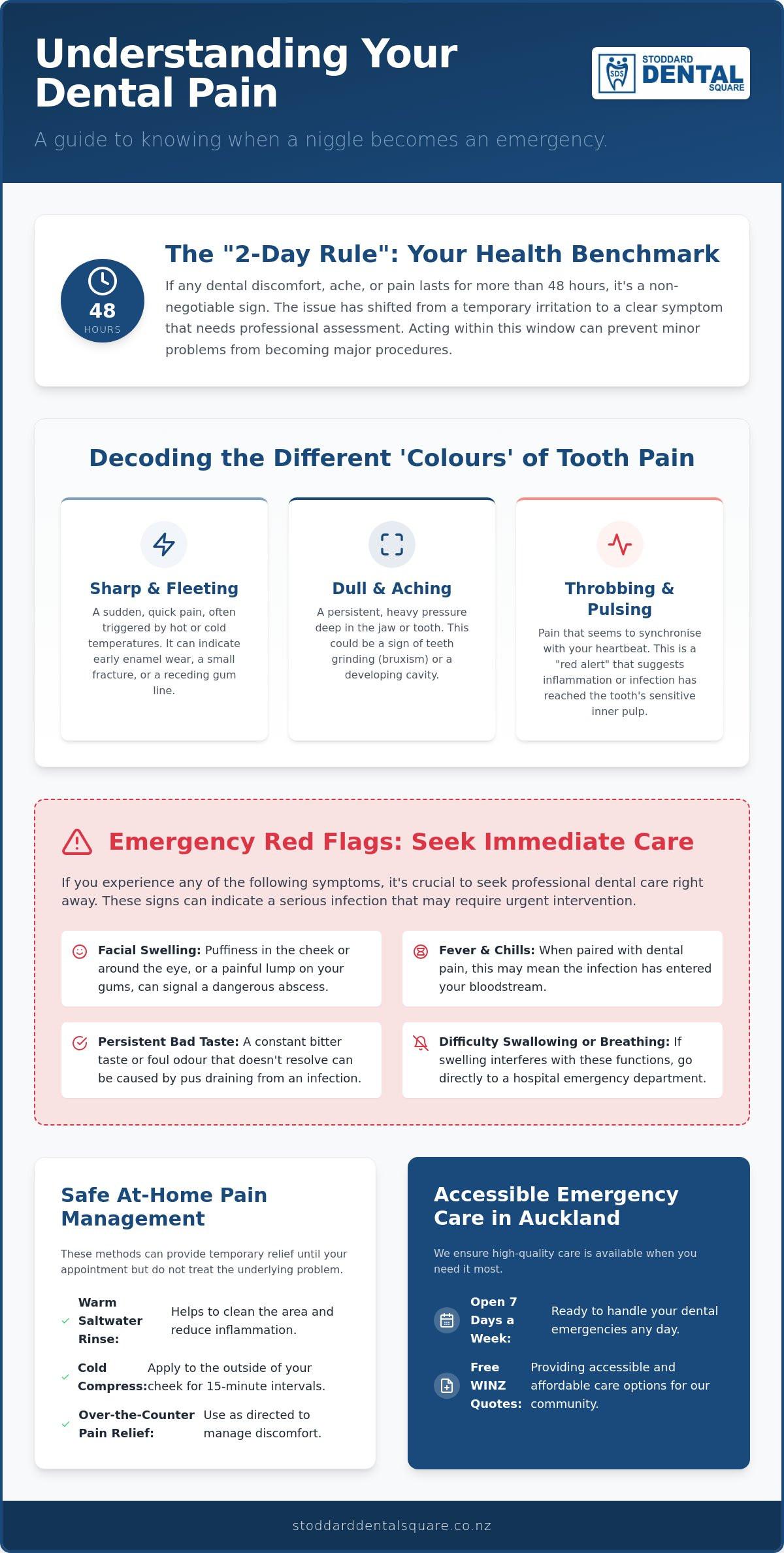
If you're unsure about dental pain when to see dentist, we recommend following the "2-day rule". This is a simple but effective benchmark for your health. If you experience any form of oral discomfort that persists for longer than 48 hours, it's non-negotiable. At this stage, the pain has transitioned from a temporary irritation to a clear symptom that requires an expert's eye. Acting within this window often means the difference between a simple, conservative fix and a more involved procedure.
The Different "Colours" of Tooth Pain
Not all pain feels the same, and the specific sensation you're experiencing can offer vital clues about what's happening beneath the surface. To better understand what is a toothache, it helps to categorise the discomfort into three distinct types. First, there's the sharp, fleeting pain that usually strikes when you're enjoying a cold gelato or a hot coffee. This often indicates early enamel wear or a small fracture. Second is the dull, persistent aching that feels like a heavy pressure deep in your jaw, which can be a sign of teeth grinding or a developing cavity. Finally, there's the throbbing pain that seems to synchronise with your heartbeat. This is typically a "red alert" sensation, suggesting that inflammation or infection has reached the tooth's pulp.
Why Waiting Can Lead to More Complex Treatments
Delaying a visit to the dentist might seem like a way to save time or money in the short term, but it almost always leads to more complex and costly requirements later. A small, manageable cavity that's caught early can be repaired with a simple filling. However, if left to grow, that same decay can penetrate the inner chamber of the tooth, eventually necessitating a root canal treatment to save the natural structure. Beyond the tooth itself, untreated gum inflammation can escalate into systemic infections that affect your overall well-being. Choosing early intervention isn't just about finding relief; it's a smart financial and health decision that protects your smile and your peace of mind.
The Top Signs You Need to See an Emergency Dentist Right Now
Identifying when a situation has escalated from a nuisance to a crisis is vital for your long-term health. While some discomfort can be managed briefly at home, certain "Red Flag" symptoms demand immediate professional attention. Facial swelling is perhaps the most critical warning sign. If you notice puffiness in your cheek, around your eye, or a painful lump on your gums, it often indicates an abscess. This is a localised pocket of infection that has the potential to spread to the jaw, neck, or even the brain if left untreated. Determining the severity of dental pain when to see dentist often comes down to identifying these high-risk symptoms that suggest the body's natural defences are being overwhelmed.
Sometimes the signs are more subtle than visible swelling. If you experience a persistent, bitter taste in your mouth or a foul odour that won't go away with brushing or mouthwash, you might be dealing with a hidden infection. This sensation is often caused by pus draining from an infected tooth or gum pocket. Understanding when to see a dentist for a toothache can help you catch these issues before they compromise your jawbone or lead to the loss of neighbouring teeth.
When Dental Pain Becomes a Medical Emergency
If your dental pain is accompanied by fever, chills, or swollen lymph nodes, the infection may have entered your bloodstream. This is a serious situation that requires urgent intervention to prevent systemic illness. In rare cases, oral swelling can become so severe that it interferes with your ability to swallow or breathe. If this occurs, please don't wait for a clinic to open. Head directly to your nearest hospital emergency department. Your overall physical wellbeing is always the priority, and our team at Stoddard Dental Square is here to support your recovery once the immediate medical risk is managed.
Trauma and Structural Damage
Accidents happen, but your response time determines the outcome for your smile. If a permanent tooth is knocked out, you have roughly a 60-minute "golden window" to have it replanted successfully. Keep the tooth moist in a container of milk or tucked inside your cheek, and seek emergency care immediately. Similarly, a broken tooth or lost crown can leave sensitive nerves exposed to bacteria and temperature changes. Loose teeth in adults are never a "natural" occurrence; they are always a cause for concern and require an urgent check-up to prevent permanent tooth loss.
Deciphering Your Discomfort: Sensitivity vs. Serious Decay
It is incredibly common to dismiss a sharp twinge as "just a bit of sensitivity." You might tell yourself that because it only hurts when you drink cold water or enjoy a morning coffee, it isn't a "real" problem yet. While we understand the desire to avoid a dental chair, this logic can be risky. There is a significant physiological difference between dentin hypersensitivity and pulpitis, and knowing the distinction is key to managing dental pain when to see dentist. Hypersensitivity occurs when your enamel thins or gums recede, exposing microscopic tubules that lead directly to the nerve. Pulpitis, however, is the actual inflammation of the internal dental pulp, often caused by deep decay or trauma. One is a manageable condition; the other is a progressive infection that requires urgent care.
To help you navigate this, we suggest a simple self-check. Ask yourself if the discomfort lingers. If the sensation vanishes the moment you swallow your cold drink, it is likely sensitivity. If the ache continues for minutes or hours after the trigger is gone, the nerve is likely under significant stress. Consulting an expert guide on what counts as a dental emergency can provide further clarity, but a professional check-up and clean is often the most reassuring first step. We can identify the exact cause and apply protective treatments to desensitise the area before a minor niggle becomes a major hurdle.
The Sensitivity Test
When assessing your symptoms at home, pay close attention to the "map" of your pain. Generalised sensitivity across most of your teeth often points to enamel wear or gum recession, which we can treat with specialised fluoride applications or lifestyle adjustments. However, if the pain is strictly localised to a single tooth, it is a much louder warning sign. You should also look in the mirror for visible cues. Are your teeth looking "longer" than usual? Visible gum recession can expose the softer root surface, which lacks the protective shield of enamel and is far more prone to rapid decay.
When Sensitivity Masks a Deeper Issue
Sometimes, what feels like simple sensitivity is actually "cracked tooth syndrome." This is a specific type of discomfort that occurs only when you bite down or, more tellingly, when you release your bite. It suggests a structural fracture that allows the tooth to flex, irritating the nerve inside. Similarly, a failing filling can allow bacteria to seep underneath, mimicking sensitivity while a cavity grows undetected. In many cases, pressure at the very back of the mouth can even be referred pain. A necessary wisdom tooth extraction can often relieve this "ghost" sensitivity by removing the source of crowding and inflammation that affects the rest of your jaw.
Safe Ways to Manage Dental Pain Before Your Appointment
Waiting for a scheduled visit while dealing with a persistent toothache is challenging. It is important to remember that home remedies are merely a bridge to get you through the night or weekend; they are not a permanent cure for the underlying infection or decay. When you're managing dental pain when to see dentist, your focus should be on reducing inflammation and preventing further irritation until a professional can intervene. Most local chemists stock effective over-the-counter options like paracetamol or ibuprofen, which can help manage the dull ache. You must always follow the dosage instructions on the packet and consult a pharmacist if you're unsure about interactions with other medications.
One dangerous myth we often hear involves placing an aspirin tablet directly against the aching gum or tooth. Please avoid this at all costs. Aspirin is acidic and will cause a painful chemical burn on your delicate gum tissue, creating a second problem alongside your toothache. Instead, keep the medication in your system as intended and focus on external comfort measures that don't risk further damage to your mouth.
Immediate Relief Strategies
A simple saltwater rinse is one of the most effective tools in your home care kit. Dissolve half a teaspoon of salt in a glass of warm water and gently swish it around the affected area. This helps draw out fluid from inflamed tissues and creates a temporary environment where bacteria struggle to thrive. If you're experiencing visible facial swelling, apply a cold compress to the outside of your cheek. Using a "20 minutes on, 20 minutes off" cycle helps constrict blood vessels and numb the area safely. Finally, if the pain is throbbing, try sleeping with your head elevated by an extra pillow. This reduces the blood pressure in your head and can significantly decrease that pulsing sensation that often keeps people awake at night.
What NOT to Do with a Toothache
While you wait for your appointment, your tooth is in a highly vulnerable state. Avoid extremely hot, cold, or sugary foods, as these can trigger the nerve and cause a fresh wave of agony. Most importantly, never attempt to "pop" a gum boil or abscess yourself. Doing so can push the infection deeper into your jawbone or bloodstream, leading to much more serious health complications. Similarly, avoid using toothpicks or sharp objects to dig into a painful cavity to remove trapped food. This often causes more trauma to the already sensitive pulp. If your pain is unmanageable or your symptoms are worsening, it's time to seek emergency dental care to prevent further complications.
How Stoddard Dental Square Makes Emergency Care Accessible in Auckland
Stoddard Dental Square isn't just a clinical space; it's a supportive, community-focused centre dedicated to the well-being of our Mt Roskill neighbours. We understand that dental pain doesn't follow a convenient schedule, and waiting until Monday morning for relief can feel like an eternity. To ensure you're never left without options, our clinic remains open 7 days a week. This weekend availability means you can access expert care exactly when you need it, avoiding the stress of prolonged discomfort. Navigating dental pain when to see dentist becomes a much simpler process when you have a local team of compassionate experts ready to provide immediate, high-quality solutions in a welcoming environment.
Our approach is built on the foundation of being a "Compassionate Expert." We recognise that many people feel a sense of trepidation when visiting the dentist, especially during an emergency. Our team is trained to prioritise your comfort, using gentle methods and clear communication to alleviate any anxieties. We believe in empowering our patients through education, acting as your guide to help you understand your treatment options without the pressure of sterile, high-register jargon. From the moment you walk through our doors, our focus is on your peace of mind and long-term oral health.
Affordable Care: WINZ Approved and Transparent
Financial worry should never be a barrier to essential healthcare. It's a reality that 42% of New Zealand adults find dental care costs challenging, which is why we are committed to being a WINZ approved dentist. If you're eligible for government assistance, we can provide a Free WINZ Quote during your emergency assessment. This document is essential for accessing the immediate financial support provided by Work and Income, which can cover up to $1,000 for essential treatment within a 52-week period. Our team will guide you through this process with transparency and care, ensuring you can focus on recovery rather than the budget.
Your Next Steps to a Pain-Free Smile
If you are currently experiencing persistent discomfort, we encourage you to act sooner rather than later. Choosing to "wait and see" often allows a minor issue to develop into a more complex infection that is harder to treat. Our Mt Roskill location is easily accessible for residents in Mt Albert, New Lynn, and Point Chevalier, offering a reliable path forward 7 days a week. You don't have to navigate this journey alone. We're here to help you move past the pain and get back to your best with the professional, meticulous care you deserve. Contact us today to secure your appointment and take the first step toward a healthy, comfortable smile.
Take the First Step Toward a Pain-Free Smile
Don't let a minor niggle develop into a major health crisis. We've explored the essential 2-day rule and the critical red flags, like facial swelling or persistent throbbing, that signal a need for immediate action. Understanding the nuances of dental pain when to see dentist empowers you to make informed decisions for your health and your budget. Whether you're dealing with a sharp twinge or a deep, pulsing ache, professional intervention is the only way to ensure the underlying cause is resolved permanently.
Our team at Stoddard Dental Square is here to provide the expert guidance and gentle care you deserve. As a WINZ Approved Dentist open 7 days a week, we specialise in emergency care and wisdom teeth, ensuring that high-quality treatment is always accessible. We pride ourselves on being a supportive partner in your health journey, removing the stress from urgent visits with transparent advice and empathetic service.
Book your emergency appointment or request a Free WINZ Quote at Stoddard Dental Square today. You don't have to manage discomfort alone; we're ready to help you get back to feeling your best.
Frequently Asked Questions
How long can I leave a toothache before it becomes dangerous?
You should follow the "2-day rule" for any oral discomfort. If your pain persists for more than 48 hours, it's a clear signal that the underlying issue won't resolve on its own. Leaving an active infection longer than this can allow bacteria to spread to your jawbone or bloodstream, potentially leading to more severe systemic health complications that require hospital intervention.
Can I go to a GP or hospital for dental pain in Auckland?
A GP can offer temporary pain relief or antibiotics, but they cannot treat the physical cause of a toothache. You should only head to a hospital emergency department if you experience difficulty breathing, trouble swallowing, or extreme facial swelling that closes the eye. For all other instances of dental pain when to see dentist is the only way to receive a permanent clinical solution.
What happens if I have a dental emergency on a Sunday?
You don't have to wait until Monday morning to find relief. Our Mt Roskill centre is open 7 days a week, specifically to ensure that Aucklanders have access to professional care during weekend crises. We understand that emergencies are unpredictable, so we maintain a full team on Sundays to handle everything from broken crowns to severe infections in a calm and supportive environment.
Is a tooth abscess a life-threatening emergency?
Yes, an untreated abscess can become life-threatening if the infection enters the bloodstream or spreads to the neck and brain. This is known as sepsis or Ludwig's Angina, and it's a serious medical crisis. If your dental pain is accompanied by a high fever, chills, or a rapid heart rate, you must seek emergency dental or medical care immediately to clear the infection safely.
What should I do if my child knocks out a permanent tooth?
Time is the most critical factor, so try to reach a dentist within 60 minutes. Pick the tooth up by the crown, never the root, and gently rinse it with milk if it's dirty. Keep the tooth moist by placing it in a small container of milk or the child's own saliva. This "golden hour" provides the best chance for us to successfully replant the tooth and save the natural structure.
How much does an emergency dental visit cost if I have a low income?
Financial assistance is available to ensure you don't have to suffer in silence. If you're on a low income or hold a Community Services Card, you may be eligible for up to $1,000 in non-repayable assistance from WINZ for immediate and essential dental work. We're here to help you navigate this process by providing the necessary documentation and support to make your care affordable and accessible.
Can I get a WINZ quote for a root canal or extraction?
Yes, as a WINZ approved dentist, we frequently provide quotes for essential emergency procedures. Whether you require a root canal treatment to save a tooth or a necessary extraction to stop an infection from spreading, we can issue a formal quote for you to take to Work and Income. This helps remove the financial stress, allowing you to focus entirely on your recovery and comfort.
Why does my tooth pain get worse when I lie down at night?
This common phenomenon is caused by changes in blood pressure. When you lie flat, more blood flows to your head, which increases the pressure on the already inflamed nerves inside your tooth. This extra pressure intensifies the pulsing sensation, which is why many people find their dental pain when to see dentist becomes much more noticeable and distressing during the quiet hours of the night.